


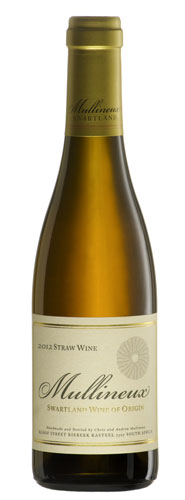
Mullineux Straw
Much talk has been made of the search in SA for cooler wine regions. This search began with Hamilton Russell in the Hemel-en-Aarde Valley and then subsequently Elgin and the very Southern Cape Agulhas. But very exciting wines have also emerged from warmer regions such as the Swartland. Mullineux is the part of this Swartland renaissance. This supports my contention that cool and warmer regions pose different challenges and that the variant climatic conditions that they bring can result in equally exciting wines. It is not a case of cool conditions being superior to warm but rather the different expressions they bring to the wines produced there. It is a positive that SA possesses both as it adds variety of character and versatility to our wine production.
At a recent tasting at Caroline Fine Wines in Cape Town wine maker Chris Mullineux presented an outstanding range of the Mullineux wines. He started off by discussing many of the challenges, achievements and ambitions facing Mullineux. Mullineux was rated by the Mail and Guardian as one of the top 20 wineries in SA. It has also received top ratings in Platter. It is relatively new, being established in 2007 with a first vintage in 2008.
Chris stated that they are “very focused” but not an estate but rather “work with grapes all over the Swartland.” This enables them to source the best that the Swartland has to offer and all the terrior variations that this brings. They are “pretty small 100 tons.” “What works well are Mediterranean varieties. Plus old vine Chenin.” In fact the Swartland is a treasure trove of old vines. Old vines can bring a greater concentration and character. Mullineux offer two ranges. The Kloof Street and Mullineux. The Kloof Street wines are more “accessible, enjoyable.” From the tasting I found this too. They are produced from younger wines but Chris points out that in the “Swartland this is relative” as the younger vineyards are 30-35 years with the older vineyards being up to 60 years. All this reminds me of some of the famed old vine Shiraz being produced in Australia from producers such as Henschke with their famous Hills of Grace.
Onto the tasting. The Kloof Street Chenin Blanc 2013 is clear straw with the nose shy and musky and grapey with a faint hint of apricots. It has a lovely rich and round palate.
The Mullineux White 2012. A white blend. Off gold with the nose musky and shy but as the wine opened up in the glass beautiful floral notes emerged. The palate is more dry and austere than the previous wine but very powerful.
The Kloof Street Swartland Rouge 2012. Even ruby with a lovely nose of cream, cloves and spices. The palate smooth and round. Both the Kloof Street wines are very accessible and enjoyable.
Now onto a flight of three Mullineux Syrahs. Chris points out that in warmer areas like the Swartland “you need blending- in a Mediterranean climate.” The first Syrah is a blend but the next two are from single sites.
The Mullineux
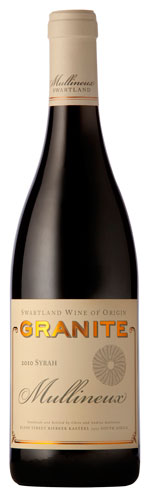
Granite
2011 is even garnet with a hint of cloves and spice on the nose. The palate is rich and creamy. Well integrated with the tannins in balance.
The Granite Syrah 2011 is deep garnet with the nose creamy and brooding with a hint of liquorish. The palate is very concentrated and intense. It coats the tongue!
The Schist Syrah 2011 is almost purple. The nose shy. The palate tight and very austere. The tannins grip the tongue. This wine needs time in the bottle…
Onto finally the desert wine I was so looking forward to. The Mullineux Straw 2012.
Chris explained that straw wine is made in France and Italy. The grapes are picked at a normal sugar level-capturing the acidity. It is air dried until the grapes are almost raisins. The sugar and acidity doubles reaching 280 grams making it one of the sweetest desert wines in SA.
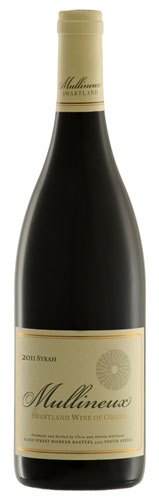
Syrah
This wine was muddy gold with apricots on the nose. Made from Chenin it showed tremendous concentration on the palate with apricots. The acidity encased in syrupy fruit.
I absolutely loved it and drank the whole tasting glass with relish. A very different example of desert wine coming from SA. Different in character but an excellent harmony of acidity and intense sweetness.
Harmony and balance are the two key words characterizing the wines produced by Mullineux. Chris stated in his conclusion that his aim over all “is to find balance in the Swartland in a warm area.” He has certainly achieved this. One of the challenges is making sure that the alcohol levels don’t get too high and all of the wines at the tasting were below 14% degrees. I must say that although I had heard a lot about Mullineux the wines were new to me and I was highly impressed. They possess an intrinsically unique and specific character and definitely make an important contribution to the wine renaissance taking place in the Swartland.


